
Rebecca Zook - Math Tutoring Online

Get your free copy of 5 Tips You Must Know to Stop Freaking Out About Math!

Call me free of charge to discuss your situation, and we'll see if I can help.

617-888-0160

Triangle Suitcase: Rebecca Zook's Blog About Learning rssfeed

Posts Tagged as "failure"

The Rhyme and Reason of making mistakes

Wednesday, August 17th, 2011

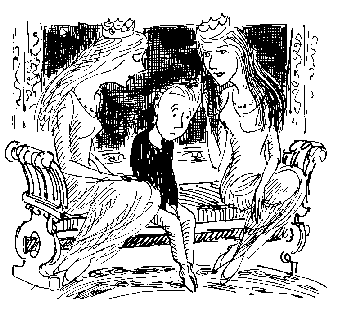
“It has been a long trip,” said Milo, climbing onto the couch where the princesses sat; “but we would have been here much sooner if I hadn’t made so many mistakes. I’m afraid it’s all my fault.”

“You must never feel bad about making mistakes,” explained Reason quietly, “as long as you take the trouble to learn from them. For you often learn more by being wrong for the right reasons than you do by being right for the wrong reasons.”

-Princess Reason in The Phantom Tollbooth by Norton Juster; illustration by Jules Feiffer

I’ve recently been working with a student who frequently beats herself up for making mistakes. Today I paraphrased this quote to her and explained that it’s okay to make mistakes as long as you learn something from them. She listened, but I wasn’t sure if it had sunk in.

Later in the session, *I* made a mistake, and I jokingly berated myself about it. She matter-of-factly responded: “it’s okay to make a mistake as long as you learn from it,” and smiled at me.

That’s when you know they get it. When they tell you what you told them.

Related Posts:
Failure is not the enemy
How to help kids be okay with things being hard
Is multi-sensory learning hardwired into our humanity?
How to make it safe for kids to fail

Posts Tagged as "failure"

On seriously owning your mistakes

Wednesday, June 16th, 2010

From The Week:

[Jim] Joyce, a veteran major league baseball umpire, last week mistakenly called a runner safe on a close play at first base on what should have been the final out, therefore costing Detroit Tigers hurler Armando Galarraga a perfect game.

Over 135 season and tens of thousands of major league games, only 20 times has a pitcher retired 27 straight batters without a walk, a hit, or an error. Joyce’s blown call denying Galarraga that 27th out, therefore, caused a national uproar.

To his credit, Joyce freely admitted after viewing the videotape that he should have called the runner out, and sought out the 28-year-old Galarraga to apologize. Clearly shaken, Joyce told reporters, “I just cost the kid a perfect game. It was the most important call of my life.” Galarraga hugged Joyce and told him to forget it. “Everybody’s human,” he said.

I was so moved by this that I cried. Mistakes are essential to learning, and we need to make it safe for kids to make mistakes so that they can learn. But we live in a world where it is so rare for anyone to publicly admit they made a mistake. Most public figures, instead of owning their failures, minimize or deny them. To see two public figures handle this huge mistake with such dignity and compassion really inspired me.

Related Posts:
Failure is not the enemy
Power of Praise (1)

Posts Tagged as "failure"

Failure is not the enemy

Wednesday, May 12th, 2010

A few years ago, I was tutoring a ninth grader who was struggling in her geometry class. Her teacher’s teaching style didn’t mesh with her own learning style, and she also had a lot of test anxiety, so even when she began to master the material, it wasn’t yet showing through on her tests.

As we worked together, I observed my student slowly replacing her overwhelmedness with genuine interest and enjoyment. She started tackling difficult proofs, and her eyes would light up with excitement and understanding when all the pieces fit together. We were a few months into the long-term project of slowly building up her understanding when her dad made a decision, without my input, to pull her out of her geometry class because she was “in danger of failing.”

Even though my student understood the material, she got so nervous on the tests that if you just looked at her test scores it looked like she couldn’t do geometry. But she could! She consistently did it perfectly, by herself, in our tutoring sessions! When we reviewed her tests, the material made sense to her once she was outside the testing environment. And I was confident that she could pull up her grades if we continued working together.

In the sessions before her dad switched her math classes, I asked my student what she wanted to do. She told me that her choice would be to switch to another geometry class at the same level, but just with a different teacher. But for whatever reason, she didn’t perceive this option as being available to her—I’m not sure if it was a scheduling issue, a political issue, convenience, parental pressure, or something else.

What her dad decided to do was switch her into a “problem solving” class. My student and I met one last time after she switched into this class. Her book made me want to cry—it was a bunch of reasoning problems about things like Corey the Camel carrying bananas across the desert. (I’m serious. It really had problems featuring Corey the Camel.) The material was basically elementary-school level—no algebra, no geometry. Just simple word problems. Maybe the geometry class was 15% too hard for her, but this “problem-solving” class was about 100% too easy for her.

After that session, I did something I’d never done before. I wrote an email to the dad, explaining as diplomatically as possible and at great length that I really didn’t think this new class was appropriate for his daughter. I explained how much his daughter loved working on Geometry and was learning a lot even if she wasn’t yet testing well. And I expressed my concern that this class would limit her in the future, since basic algebra and geometry were prerequisites for so many other disciplines.

I wrote, wouldn’t it be better for her to take geometry and learn some geometry, even if she got a “failing” grade, than for her to take a class where she would learn nothing at all?

Her father’s response was vituperative. How dare I suggest that he allow his child to “fail!” And I never saw either of them again. I honestly don’t know how I could have handled this differently, but my heart still breaks for that student.

In comparison, another student’s family handled the perceived threat of failure very differently. I was working with a ninth grader who was struggling with Algebra 2 because her elementary school had failed to teach her basics like long division (she was supposed to “figure it out for herself”.) I believe when we started working together she was failing the class.

I was extremely proud of how hard this student worked, and she finished the year with either a low B or a high C. At the end of the year, her algebra 2 teacher suggested that she consider voluntarily repeating the class, just to strengthen her skills before moving on to more advanced math.

My student chose to repeat the class, even though she felt at least a little bit embarrassed to be the only sophomore in that class full of freshmen (at least I figured this was the case since she joked about it). She chose to learn instead of to look good. And her parents supported her. I was so impressed with her integrity.

By the end of her second time through algebra 2, the material that had brought her to tears the previous year did not phase her at all. But I think about the other family,
and how they didn’t want to let their daughter fail. Did that student ever get another chance to love geometry? Was she stuck in remedial math classes for the rest of high school? What did she did she do for her math requirements in college? I wish I knew. I hope she got another chance, instead of internalizing a message that she “couldn’t do math.”

Why do we protect our kids from failure, even to the detriment of their own learning?

Related Posts:
I cried myself to sleep over my algebra homework
Algebra Tears
“I Think I See A Mathematician!”

Posts Tagged as "failure"

Power of Praise (1)

Wednesday, October 28th, 2009

Po Bronson’s awesome New York Magazine article, The Power (and Peril) of Praising Your Kids, reports on psychologist Carol Dweck, who has been researching the effect of praise on students for ten years. In a series of experiments with 400 fifth-graders, research assistants gave students a nonverbal IQ test consisting of a series of puzzles.

When the students finished, they were given their score and a single line of praise: either “you must be smart at this,” or “you must have tried really hard.” In the second round of tests, students could either pick an easy test like the first one, or a harder test. Ninety percent of those praised for their effort picked the harder one. The majority of students praised for their intelligence picked the easier one.

Here’s where it gets really crazy. In a third round, all students were given a very difficult test designed for students a grade ahead of them. Everyone failed. The students who were praised for their innate intelligence were “sweating and miserable” and assumed that because they couldn’t figure out the puzzles, they weren’t smart after all. The students who were praised for their effort just tried harder, and “many of them remarked, unprovoked, ‘This is my favorite test.’”

Dweck had suspected that praise could backfire, but even she was surprised by the magnitude of the effect. “Emphasizing effort gives a child a variable that they can control,” she explains. “They come to see themselves as in control of their success. Emphasizing natural intelligence takes it out of the child’s control, and it provides no good recipe for responding to a failure.”

I feel like I’m already extremely sensitive to every word I say to my students. I would never say anything to imply that they weren’t capable of doing something. In my experience, students respond extremely well to the praise and encouragement that I give them, and I believe it helps them feel more confident and relaxed about the learning process. A lot of my praise is pretty general: “Awesome!” “You got it!” “Good work!” “Great!”, right after they do something correctly or finish a problem. But I wouldn’t be surprised if a few “You’re so smart!”s or “You’re good at this!”s slipped in there.

Would that be so bad? By the time my students have come to me, they’ve probably gotten a lot of negative feedback on their math abilities, be it objective or subjective. And they probably have a lot of negative self-talk. If someone’s convinced that they’re “bad at math,” is it really wrong to indicate that they have natural ability at some point?

However, reading about this research is causing me to examine my entire attitude toward praise. Remembering one particular incident really makes me cringe. I had a student who had told me in the past that he loved Latin. He was struggling in school, and I wanted to encourage him. I remembered that in Boston, in addition to the high demand for math tutors, there was also a really high demand for Latin tutors, since a lot of middle and high schools require Latin.

I mentioned this to him in the context of, “You’re good at Latin, maybe you’d enjoy tutoring people in it, and you could make a ton of money,” and he responded, “I never said that I was good at Latin. I said that I liked Latin.” I felt like the worst tutor in the universe. I thought I was encouraging him, but actually, I was praising an “innate capability” he himself didn’t believe he possessed. I wish I could take back what I had said.

Followup: This same research on praise is discussed in Po Bronson and Ashley Merryman‘s amazing new book, NurtureShock, which I recommend you read in its entirety!

Related Posts:
Power of Praise (2)
Power of Praise (3)
Praise and Intrinsic Motivation–An Answer?