
Rebecca Zook - Math Tutoring Online

Get your free copy of 5 Tips You Must Know to Stop Freaking Out About Math!

Call me free of charge to discuss your situation, and we'll see if I can help.

617-888-0160

Triangle Suitcase: Rebecca Zook's Blog About Learning rssfeed

Topic: recommended resources

Yay, it’s a new math book from Danica McKellar!

Saturday, August 18th, 2012

Celebration! Danica McKellar has released her latest math book for girls, Girls Get Curves!

McKellar recently did a really thoughtful interview with NPR about her latest book, which focuses on geometry. One of my favorite parts is this bit, when she talks about taking her first college math class at UCLA:

I was actually worried about taking a math class. I didn’t know that I’d be able to handle it. And here I scored a five on an AP Calculus BC exam. Talk about perceptions. I didn’t see myself as being good at math even though I was. And that’s one of the things I’m tackling in the books. But when I did jump into that math class, despite my concerns and my fears, I did really well and I was hooked.

I was like, wow, I suddenly felt valued and important for something that had nothing to do with Hollywood. It had everything to do with something that I was building from the inside out, and you don’t have to have been on television to struggle as a teenage girl with your self-image. And that’s why I know that math is an amazing tool for all girls to find themselves, to find something that they value themselves for.

Because I admire Danica and share with her a mission of helping girls (and guys too) really GET math in a way that is fun and meaningful, I’ve read a lot of her interviews very closely (and I even got the chance to interview her myself about her third math book for Wired’s GeekMom blog — check it out here). I’ve heard her talk about how doing a difficult math problem during college would make her euphoric, and her journey of becoming a math major.

But this is the first time I’ve heard her talk about experiencing math as a refuge – a place where you can incubate and develop your own abilities and intellectual strength and work “from the inside out” in a way that has nothing to do with appearances.

This vision really resonates with me — and I hope that all girls (and guys) can experience math this way.

Would you love to experience math as a refuge – even if right now, you might not be sure that it’s possible to ever regain your confidence? Give me a call at 617-888-0160 or email me at rebeccazook@gmail.com, and I’d be happy to set up a time for us to have a conversation about what’s going on and look into whether or not it would be a good fit for us to work together one-on-one!

Related posts:
Guest Post Alert: Q&A with Danica McKellar About Hot X: Algebra Exposed!
No More Girls Versus Boys
My Favorite Math Teacher Is a Woman
How to help your kids with their math homework

Topic: recommended resources

Physicalizing Math With Body Music

Thursday, October 27th, 2011

If you’re an educator (math or otherwise) & you’re lucky enough to be in the San Francisco Bay Area next week, my wonderful colleague, Linda Akiyama, is offering some workshops in physicalizing math using body music. I had the pleasure of meeting Linda and experiencing her work in person last year, and her work is a delightful, fun, and deep multisensory way of helping kids learn math and understand it in every cell of their being. (Using rhythms to find least common multiples, anyone?)

If it’s geographically possible for you, go, go, go! And take your friends! Details follow.

Crosspulse & THE 4th INTERNATIONAL BODY MUSIC FESTIVAL present

ALL NEW TEACHER TRAINING WORKSHOPS

Integrating Arts & Academics: Physicalizing Math using Body Music

• Learn Rhythm Blocks, an easy yet effective rhythmic approach for teaching essential math concepts & skills

• Create instructional activities that motivate and inspire your students through arts integration

• Discover how to use Body Music to fully engage your students in math learning and beyond

• Basic Rhythm/Basic Sanity – learn to cultivate calm in the classroom

Tuesday, November 1

San Francisco School
300 Gaven St., SF
4pm-6pm, $25
Terry, Akiyama, Goodkin

Thursday, November 3
First Unitarian Church
685 14th St @ Castro, Oakland
4pm-6pm, $25
Terry, Akiyama, Santi Owen

Instructors:

Keith Terry is the Artistic Director of the IBMF, and has developed a Body Music methodology well-used by classroom and music teachers for a host of applications throughout curricula. Keith has two instructional DVDs on Crosspulse Media, with the third DVD and accompanying book due out in 2012.

Linda Akiyama has 25 years of experience teaching in public elementary schools and has taught science education courses through the SEP program at UCSF. She uses rhythms, chants, and rhymes extensively to support the teaching of academic subjects.

Doug Goodkin teaches music based on Orff Schulwerk to children 3 yrs – 8th grade at The San Francisco School. A director of the prestigious San Francisco Orff Course and author of many books on music education, Doug travels extensively internationally giving courses on Orff Schulwerk.

Jim Santi-Owen has taught for nearly 20 years in public and private schools as a music specialist. Trained by some of the top percussionists in the world, and a certified Orff instructor, Jim is currently the Music Director for the San Francisco World Music Festival where he also directs the Festival’s International Youth Orchestra.

To reserve a space, purchase advance tickets at www.brownpapertickets.com. Tickets also available at the door.

For more information on IBMF concerts and workshops, including a Family Matinee Sunday Nov 6, visit www.internationalbodymusicfestival.com

Topic: recommended resources

It’s time to dance… MATH dance!

Wednesday, August 3rd, 2011

What an awesome way to remember what some of the essential functions look like!

Beautiful Math Dance Moves

Next time one of my students needs to remember what a function looks like, I’m gonna say, “Let’s DANCE!!”

*Via coeurdewhale at tumblr (I believe this is who created the image, but I’m not sure) and dong6241 at piccsy, a lovely site that showcases user-submitted images and has a great visual image search (blogger’s delight)!

Related Posts:
Gallon Man to the Rescue!
An easy way to remember how logarithmic notation works
Self-made heroes: the dancers of Planet B-Boy

Topic: recommended resources

Got the summer math packet blues? Try some Purplemath

Friday, July 15th, 2011

This goes out to all the kids who are working on summer math packets without having a textbook to refer to. If you need a good online math reference, I highly recommend Purplemath (one of my personal favorite math websites).

This site has a GREAT lessons index so you can quickly find the exact topic you need. The lessons (written-out explanations) are very thorough and easy to follow. They’re not written like a math book, but like having someone really smart and kind explain things to you in a conversation. The lessons do an excellent job of going over concepts AND steps, integrating the “what do I do?” with the “why it works!”

The site also features community forums sorted by level—starting with arithmetic and going all the way up to trigonometry. So if you have a math question, you can post it in the appropriate forum and get help from other community members. Elizabeth Stapel, the founder of purplemath, frequently responds to students’ posts in the forum herself!

Thank you, Elizabeth Stapel, for this totally user-friendly and expert site!

Related Posts:
The best algebra book in the world?
I am SO EXCITED about Math U See!
Q&A with Danica McKellar, author of Hot X: Algebra Exposed!
Five fun ways to help your kids learn math this summer (online!)

Topic: recommended resources

Surface Area of a Cylinder Song

Sunday, May 1st, 2011

Here’s a fun way to remember the formula for surface area of a cylinder—singing these lyrics set to the tune of Camptown Races (in the style of Foghorn Leghorn):

2 times pi times r times h; that’s the middle.
2 times pi times r times r; top and bottom, too.
Surface area!
Of a cylinder! It’s
2 times pi times r times h plus two times pi times r times r.

If you’re not sure about how to fit the lyrics with the Camptown Races melody, just listen to the intro of this sweet rendition on YouTube:

With this handy mneumonic device stuck in my head, I feel the urge to belt “Surface areAAAA! Of a cylinDERRRR!” while walking around my neighborhood and puttering around my kitchen!

Many thanks to Becky Brickell for sharing this great idea on the Texas Instruments Classroom Activities website!

Related Posts:
What Does Pi Sound Like?
There’s Always Room for Cello
Happy Pi Day – a beautiful song about 3.14159…
Five fun ways to help your kids learn math this summer with rock songs and raps

Topic: recommended resources

Greater than / Less than signs – taking the alligator thing to a whole new level

Wednesday, October 6th, 2010

Growing up, I remember learning to remember the difference between the greater than and less than signs by imagining a hungry alligator with an open mouth getting ready to “eat” the bigger number.

I recently got to work on this concept in an online tutoring session with a student of mine who’s a fifth grader.

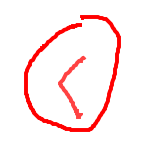
First we had a regular < sign and we talked about the "alligator" idea.
2010-10-05_2349

He drew in some pointy alligator teeth:
2010-10-05_2350

Then he spontaneously drew a whole alligator:
2010-10-05_2345

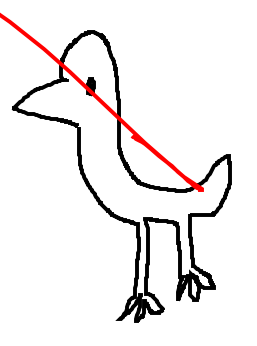
As we worked on different inequality problems, he took it further. He drew a picture of a bird and explained that the bird’s closed little beak is shaped like an inequality sign. The bird would go for the smaller meal, while the alligator would go for the bigger meal.

2010-10-05_2346

And he topped it off – with sound effects.
2010-10-05_2348

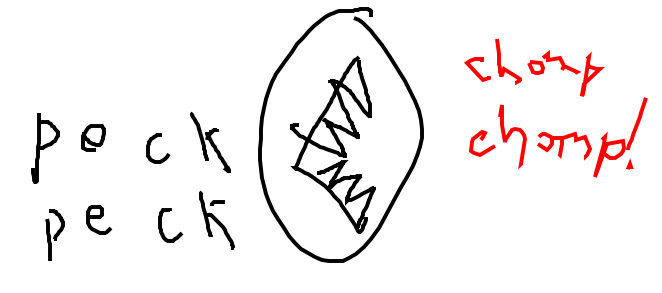
The smaller number, which the bird would eat, has a “peck peck” sound. The larger number, which the alligator would eat, has a “chomp chomp” sound. Oh my gosh, I love it!

I’d never seen the alligator metaphor pushed this far before, and I wanted to share my student’s creative ideas!

What’s your favorite way to remember (or teach) the difference between the two signs?

Related posts:
Confused about fractions? Visualize brownies, not pizzas
Gallon Man to the Rescue!
Five fun ways to help your kids learn math (this summer)

Topic: recommended resources

Confused about fractions? Visualize brownies, not pizzas

Friday, September 3rd, 2010

Pizzas. They’re the best way to represent fractions, right? Everyone has seen a pizza. Everyone knows you can slice a pizza different ways. When you need to visually represent fractions, pizzas are the go-to metaphor, right?

Well, that’s what I thought until I tried using pizzas to teach equivalent fractions. Sure, it’s easy to use a pizza to represent quarters, sixths, eighths. Thirds aren’t even too bad.

But just try dividing a circle into five equal pieces. Or seven. Or ten. Even though I’m a grown-up and a professional math educator, it’s really hard for me to consistently do this.

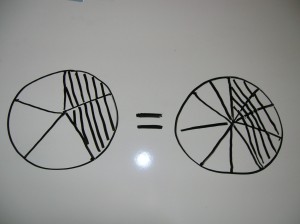
And as for showing visually how two fifths equals four tenths? Unless I do an impossibly immaculate job of dividing those pizzas into pieces, forget about it.

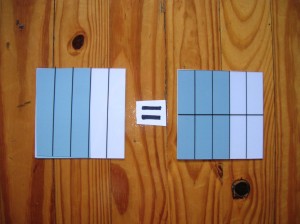
DSCN0716
Are they really the same?

Fortunately, I’ve found a much better way to represent fractions visually: the Math-U-See fraction overlays. If we’re going to use a food metaphor, they’re flat and square, like brownies from a square pan.

And like brownies, they are much easier to slice evenly than pizzas. In fact, because they’re reusable transparent overlays, you don’t even have to draw (or slice) anything. You just arrange them on top of each other.

Check it:

DSCN0717

Awwww, yeah! Those fractions are DEFINITELY equivalent!

You can use the overlays to represent basic fractions with divisors from two through seven, or combine multiple overlays to build other denominators.

Not only do they make it really easy to see how equivalent fractions work, but using them is way easier than drawing pizzas and hoping the slices come out even.

The fraction overlays make the concepts extremely clear, and because they’re tactile, visual, and kinesthetic, they make fractions feel like a game instead of work. Whenever I’ve used them with my students, either in person or during online tutoring sessions with a webcam, they’ve react the same way: “This is fun!”

Now that’s how I want my students to feel about fractions!

Related Posts:
Doing fractions “In Chinese”?!
The best algebra book in the world?
Gallon man to the rescue!
Five fun ways to help your kids learn math this summer

Topic: recommended resources

Five fun ways to help your kids learn math this summer (online!)

Wednesday, June 30th, 2010

2010-06-30_1644

I’m totally psyched! I have a new guest post up on mashable about five of my favorite fun technologies to help kids learn math over the summer — technologies which involve incorporate hip-hop, wailing rock guitar solos, talking calculators, brain science, and pirates.

So if you’ve ever dreamed of helping your kids learn their times tables by rapping, or just want to find some fun new ways to help your kids learn math this summer, click on over and check it out!

Related Posts:
Tips for how to help your kid with their math homework
The best algebra book in the world?
How to find a good math tutor
Be yourself, do what you want, wear what you love (Ada Lovelace/Coder Barbie Follow-Up)

Topic: recommended resources

Gallon man to the rescue!

Thursday, June 3rd, 2010

Do you need a way to remember unit conversion effortlessly and forever? Or just a way to calculate how many cups there are in a gallon?

Here’s how to figure it out. Draw a gallon man!

First, draw a really big capital G. (This is the gallon.)
2010-06-01_1305

Inside the G, draw four big Qs. (These are the quarts.)
2010-06-01_1307

Inside each Q, draw two Ps. (These are the pints.)
2010-06-01_1308

Inside each P, draw two cs. (These are the cups.)
2010-06-01_1309

For the final flourish, draw an arrow to one of the cs and write “8 ounces.” (There are eight ounces in every cup.)
2010-06-01_1310

When one of my students, a fifth grader, taught me about Gallon Man, I thought, I wish I had learned about this in fifth grade! My entire life, I’ve had to look up each of the conversions and never really internalized how they all fit together.

Since I’ve been introduced to Gallon Man, I’ve gleefully shared him with a fourth grade tutoring student (online), a friend who is a professional organic farmer (in person), innocent bystanders (at a restaurant), and most recently, my Mom (over the phone…”first, draw a really big G…”)!

They’ve all found Gallon Man helpful. Responses have included: “Can I take that drawing home with me?”, “Oh…I get it!”, and “I’m going to hold onto this.”

Gallon Man is totally visual and works for many learning styles. You can SEE how many quarts are INSIDE a gallon. Gallon Man is intuitive for all grade levels (unlike dimensional analysis, you don’t have to worry about the numerators or denominators). Gallon Man is practical. You can use it in your kitchen or in the grocery store. Gallon Man is easy to remember. And Gallon Man is fun to draw!

Gallon Man has recently gotten some airtime from other math bloggers, including Sam J Shah, who pointed out that it really helped him to see someone drawing Gallon Man. Here’s Sam’s post and video.

Yay for mnemonic devices!

*Are you looking for an online math tutor who uses multisensory methods? I’d love to help! Give me a call at 617-888-0160 to discuss your situation.

*Visiting from the Math Teachers at Play Carnival (Adventure Edition)? Welcome, I’m glad to see you here! Below are a few other posts you might enjoy!

Related posts:

Tips for how to help your kid with their math homework
Doing Fractions “In Chinese”?!
An easy way to remember how logarithmic notation works
Case study: a homeschooler prepares for the SAT

Topic: recommended resources

It’s 3.14 – Happy Pi Day!

Sunday, March 14th, 2010

To celebrate 3.14 – PI DAY – here is a beautiful music video of an awesome song about PI !!

It’s a delightful way to learn or remember some important facts about this lovely number, 3.14159….

Here are the lyrics. I would love to know who wrote the song (couldn’t figure it out on google) and who made the gorgeous video (the info was all in Russian).

(Thanks to Sue Van Hattum for posting this on *her* blog today, and to Maria D for sharing it on her Natural Math google group!!)